Packaging lines depend on consistent, reliable coding. When a coding system falls short, the impact shows up immediately — unreadable codes, increased rework, unnecessary downtime, and added operator involvement.
Laser coding systems address these challenges by delivering permanent, high-quality marks without the need for inks, solvents, or ribbons. They are designed to run at production speed with minimal maintenance, making them a long-term solution for improving efficiency and consistency.
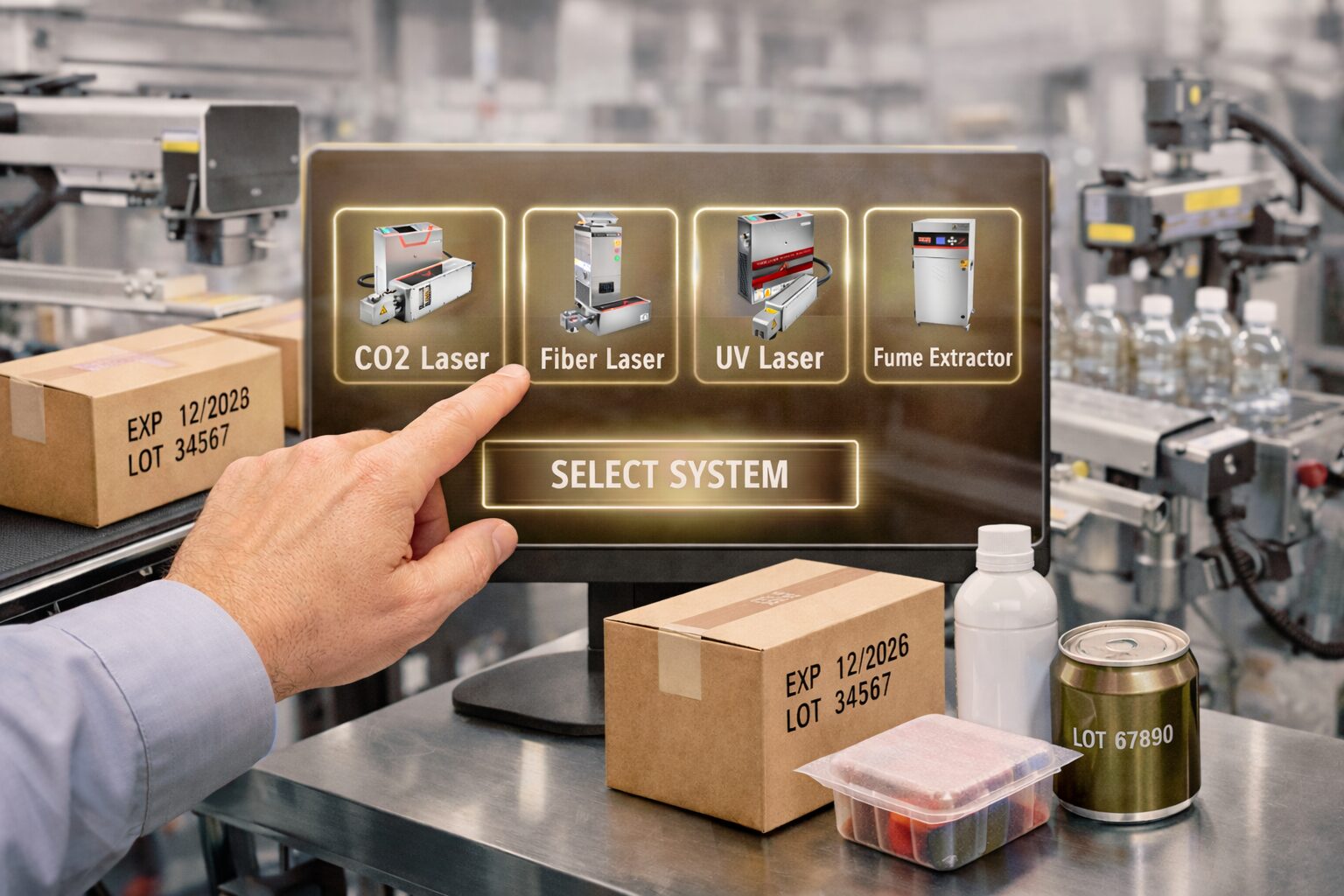
The critical factor is selecting the correct laser technology based on material type, application, and production requirements.
Explore the full range of available systems: laser coding systems
CO2 Laser Coders for Standard Packaging Applications
CO2 laser systems are widely used across packaging operations where materials can tolerate heat and high-speed performance is required.
The SQ-10 CO2 Laser Coding System is designed for marking on cartons, labels, and corrugated packaging. It delivers consistent, high-contrast codes for applications such as date coding, lot tracking, and barcoding. For higher-speed production environments, the SQ-30 CO2 Laser Coding System provides increased output capability while maintaining code quality. It is well-suited for operations with higher throughput demands where reliability and speed are equally important


Typical applications include:
- Food and beverage packaging
- Consumer goods and retail packaging
- Corrugated cases and folding cartons
CO2 laser coders provide a dependable solution for standard packaging materials, offering consistent performance with reduced maintenance requirements.
Fiber Laser Coding for Metal and Industrial Applications
For applications involving metals and rigid materials, fiber laser systems provide a more appropriate solution.

The SQ-50F Fiber Laser Coding System is engineered for permanent marking on materials such as stainless steel, aluminum, and engineered plastics. It is commonly used in industries where durability and traceability are critical, including automotive, electronics, and medical device manufacturing.
Fiber lasers produce high-contrast, permanent marks that remain legible over time, even in demanding environments. This makes them ideal for part identification, compliance marking, and long-term tracking.
UV Laser Coding for Sensitive Materials
UV laser systems are designed for applications where material sensitivity is a concern and heat must be minimized.
The SQ-UV-A Laser Marking System uses a low-heat process to create precise, high-resolution marks without damaging the substrate.

Common applications include:
- Pharmaceutical packaging
- Cosmetic and personal care products
- Flexible packaging and films
UV laser technology is particularly effective for materials that may warp, discolor, or degrade under higher heat, ensuring both product integrity and code quality.
Fume Extraction for Safe and Efficient Operation

Laser marking processes can generate fumes and airborne particles depending on the material being coded.
The SQ-LFX Laser Fume Extraction System is designed to capture and remove these emissions, supporting a cleaner and safer production environment. It also helps protect surrounding equipment and maintain consistent operating conditions.
Fume extraction is an important component of a complete laser coding solution, particularly in applications involving plastics, coatings, or specialty materials.
Selecting the Right System
Each laser system serves a specific role within a packaging or production environment:
- SQ-10 CO2 Laser Coding System – Standard packaging materials and applications
- SQ-30 CO2 Laser Coding System– Higher-speed packaging lines
- SQ-50F Fiber Laser Coding System– Metal and industrial marking
- SQ-UV-A Laser Marking System – Heat-sensitive and flexible materials
- SQ-LFX Laser Fume Extraction System – Fume extraction and environmental control
Selecting the appropriate system requires consideration of material type, line speed, and application requirements.
Integration and Performance
Performance is not determined by the laser alone. Proper integration into the packaging line ensures that the system operates consistently at production speeds without introducing bottlenecks.
At Dartronics, laser coding systems are evaluated within the context of the full production environment to ensure compatibility with conveyors, product flow, and throughput requirements.
Conclusion
Laser coding systems provide a reliable, low-maintenance solution for modern packaging and manufacturing operations. By selecting the correct technology — and ensuring proper integration — manufacturers can improve efficiency, reduce downtime, and maintain consistent product identification.
The video below shows how these systems operate in real production environments, including CO2 marking on packaging materials and UV coding on more sensitive substrates.

OUR COMPANIES
Visit our company sites that highlight specialized machinery.

